
Go To Church!

What is your primary focus during worship? Are you thinking about God, or yourself, or all the other things that tumble around our minds?

Some of my most precious Sunday memories are meaty discussions in Sunday School, singing in the choir, playing the piano during worship, and having lunch with friends afterward.

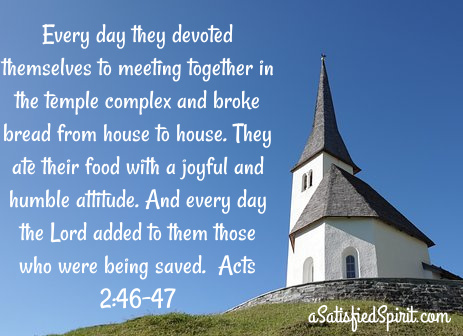
The early Christians devoted themselves to the concepts and practices of these verses. That means they planned, scheduled, and looked forward to going to church and fellowshipping with other Believers afterward.  Friends not only had lunch with one another, but they also broke bread. The word used here for breaking bread can be translated as “Eucharist”. That word tells us they followed Jesus’ command in Luke 22:19. They took communion. They didn’t have restaurants and fast food like we do, they went to one another’s homes. I imagine this was like a carry-in dinner every day. How do I know it was every day. Because the scripture says, And every day the Lord added to them those who were being saved. 

They were joyful. Joyfulness is a deep-rooted, inspired happiness.  It comes from deep inner contentment and satisfaction. Only God and knowing God can produce real joy. When we receive the Holy Spirit all the fruit of God is produced in us. Ephesians 5:22-23 gives us the list. The fruit of the Spirit is love, joy, peace, patience, kindness, goodness, faithfulness, gentleness, and self-control.  

They also had humble attitudes. It’s really important that we understand what humility and being humble really means. The Oxford English Dictionary says it is having a low estimate of one’s importance, worthiness, or merits. OK. Then Webster’s Collegiate Dictionary adds – not assertive, ranking low in a hierarchy, and insignificant. That is not at all what Luke was talking about. That’s definitely a worldly view of the humble person but, the Biblical view is quite different. In the Word, humbleness is about putting others first. Not just people but God, too. They absolutely loved to worship God.

Since many think worship only occurs one day a week and for many that means Sunday I want to ask how often you worship and if worship is a joyful time for you?

Ray and I used to travel to the Smokey Mountains every year during Spring Break. For many years we were often traveling on Easter Week. Since we choose not to drive the whole distance in one day we usually stop in Richmond, Kentucky on Saturday night and attend church on Sunday morning. Yes, worship is that important to us. We want to be with other Christians on Sunday. So for us, and for many of you, worship is as necessary as getting fresh milk and bread each week.

God’s plan also was to use the Sabbath to turn our hearts and minds toward Him. In other words, He wants us to set aside one day of the week as a special time of rest,worship, and reflection on His Word. After all, if we ignore God on that day when else are we likely to turn to Him? We get busy and preoccupied with daily living — and end up leaving God out of the picture. God’s plan is clear: “Observe the Sabbath day by keeping it holy” (Deuteronomy 5:12).

We are not to neglect fellowshipping with the Body of Christ. That’s the church, my friends. Does that mean you won’t go to heaven if you don’t go to church? No, but it does mean that we’ll miss the blessings of obedience to His Word and serving alongside other Believers.

Why are fewer people committed to going to church? I know you all know this, but we live in an ‘all-about-me’ society.  Personal preferences are outweighing obedience to God’s Word. Theology has become Me-ology. Many worship services are more like a Broadway Show than a sincere focus on God.  Comments like I don’t like the music… To many old hymns… Guitars and drums don’t make it… I don’t like the pastor’s preaching… It’s too long…  I’m not comfortable… It makes me wonder if a sanctuary of recliners would bring more people in?  No matter the issue – when things like this come between whether or not we’re going to church on Sunday we’ve definitely become “all about me” worshippers.

So what can we do about it? First of all, don’t just say it’s all about God – make it all about God.

Make worship a priority. Write it in your planner. No excuses. Commit to it!

Pray. Before attending, whether that is the night before or the morning of, pray that you will put God first. Ask Him to speak to you. Pray for others who will be attending. Just pray.  Upon entering the church, perhaps while walking through the church parking lot, pray for those who are worshipping with you, pray for the unbelievers who will be attending. Pray that all distractions are removed so it can be totally about God. Pray that God will give your pastor the words you need to hear and that your heart and mind will be open to hearing them.

Go to church Sunday! If you have never attended a church, find one. If you’re saying I can’t go to church or I’m not a Believer or I don’t even know if they’d want me. Oh, yes, we want you! Join us!

Holy vs. Common

Rosary Worship

Have you ever noticed that sometimes God puts valuable information in sometimes obscure parts of the Bible?  That nuggets of wisdom are sometimes hiding in the shadows of other information?  We’ll be lighting the shadows in today’s post and looking at Leviticus 10:8-11.

During the time God was giving the law to Moses He spoke to Aaron, his brother, once in a while too.  In this portion of Scripture He tells Aaron and his sons to distinguish between holy and common.  God uses the possibility of to much ‘wine or other fermented drink’ as an example of the kinds of worldly issues that can be brought into the arena of worship.  Basically, He’s giving the First Commandment again…You shall have no other gods before Me!

I want us to particularly look at the idea of holy and common, and what that means in our walk with the Lord.  Let’s start by defining the words:

Holy      The Hebrew word is qodesh and means a holy or sacred thing or place.   It refers to being sanctified which is being set apart for a specific purpose.  The Miriam-Webster Dictionary defines it as – exalted or worthy of complete devotion as one perfect in goodness and righteousness; devoted entirely to the deity or the work of the deity.

Common    The Hebrew word is hol and means not holy, ordinary.  Webster defines it as belonging to or being shared by two or more individuals or things or by all members of a group; falling below ordinary standards, second rate.

With the realization that these commands were given regarding the Holy Place and the use of it and its contents, there are a couple of concepts here that I think apply to my (and perhaps your) personal walk.  First, what is God’s, is God’s.  It is set aside for His purposes, it is holy.  It does not become the object of our worship.  What might this include?  Objects, robes, vestments, furniture, art, buildings, and more that have been given/set aside for His use.  I think sermons, music, lessons, VBS, Sunday School and many other activities of the church are also to be perceived as Holy.

What does it mean to distinguish between the holy and the common?  A synonym for common is ordinary.  He was telling the Priests to be aware of the ordinary invading the holy.  He wanted His place of worship to be holy, sanctified, set aside (as different) from the ordinary.  For me this means maintaining a worshipful atmosphere in the Church/Tabernacle/Cathedral that is all about God and not about the world around.  It means the things of worship are for God.

So…..What is the focus of your/my worship?  Are we bringing so much of the ordinary and common into the Temple that we no longer worship the One and Only?  Have we made the environment of worship so sterile that there is nothing of God in His Temple?  Does God even know the place is set aside for Him?

A musical moment of Holiness – What Do I Know of Holy

Heavenly Father I worship You!  Give me the ability to use the Temple as You intended.  Help me keep out the ordinary and embrace the Holy.  Oh, Lord, You are the Great High Priest!  Cause my worship to be all and totally about You.  Make it so!

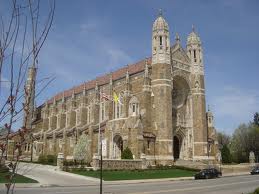
The picture at the beginning of this post and following are of the Rosary Cathedral in Toledo, OH.  The first time I was there was with the Toledo Symphony Chorale in singing the Bruckner 9th Symphony w/voices.  It took my breath away then and still does.  God’s presence was so visible.  I am in awe of what God allows man to do so He can be praised and worshiped   Don’t get me wrong,  I worship indoors, outdoors, and all the places in between, but I believe that are places that God has set aside from the ordinary to give us a glimpse of His great glory.

Rosary Exterior

Exterior of the Rosary Cathedral in Toledo OH.

Rosary CathedralThe sanctuary in the evening without worshipers.

Rosary OrganThe Pipe Organ located in upper balcony at the rear of the church.

Rosary AltarThe main altar area.

Colorful Worship

I discovered that God is very explicit about the colors He wanted used to decorate the Tabernacle while reading Exodus 26.  He told Moses to use blue, purple and scarlet.  I began to wonder why these colors?  What is important about them?

The colors are used for several articles in the tabernacle: the curtain – Ex. 26:1, the drape that separates the Holy of Holies from the rest of the tabernacle – Ex. 26:31, the High Priest ephod – Ex. 28:15, are only a few examples.

tzitzitThere is no mention of what the colors stood for but there could be a direct relationship to the idea that Jesus is fully God and fully man.  (According to Jewish scholars.) Blue always represents Yahweh.  In the tzitzit, the prayer shawl, there is a blue thread to symbolize God and His Commandments.  There is also a scarlet thread to symbolize mankind.  Woven between these colors is purple which is a combination of the primary colors – red and blue.  God (blue) and man (red) were separated by the sin in the Garden of Eden.  God never intended to leave it that way.  His plan was to have a go-between to restore the fellowship between Himself and His creation.  The go-between would be all God (blue) and all man (red), our Jesus (purple).

The colors also represent other aspects of the Judeo-Christian culture.  Holy of HoliesPurple is the color of royalty.  Jesus is the King of the Kingdom and would rightfully wear a purple robe.     It is also the color of the Royal Priesthood. Blue is the color of God’s chosen people dating back to the time of David.  The restored throne of David is described in Ezekial 1:26 as being made of sapphire (blue stone).  Red is a primary color and can not be made from any other color(s).  It is interesting that the Hebrew root word for Adam is oudem which means red clay.   Red symbolizes atonement, sacrifice, life, death, and flesh.  

I found it interesting to learn what these colors may mean.  I do not intend this to be any more than interesting information that may make your study of the Word more informative.

Heavenly Father, what a heritage You have provided for us.  Help us to remember, in whatever way necessary, that You alone are God.  Make it so!


We Are Made To Worship

Worship is built into the fabric of our souls.  When we have something good happen we shout it out, we talk about it with friends and family, we lift our hands to heaven.

Worship is woven into the Story from the beginning of the Word in Genesis through Revelation.  Let’s take a look at a few examples:

Genesis 12:8    Abram builds a personal altar to worship the One and Only

Psalms   The entire book is about a life of worship.  Through prayer and praise the psalmists lift their personal life to the Throne.

Luke 2:36-37   Anna has been a widow for many years.  Day and night, year after year, she fasts and prays, lifting praise to the LORD.

Revelation 7:11-12   This beautiful, dramatic scene gives us a picture of heavenly worship.  It’s ALL about God!

Worship can be loud.  It can be soft.  Worship can be with others or all alone.  It can be in a church, in a car, at the kitchen table or sitting on the porch swing in the mountains.  No matter where we are we are made to and for worship.

Ah, Lord, God, You alone are worthy of all my worship and praise.  You alone created the beauty around me, the people I share this life with, the stuff You have blessed me with.  Oh, Lord, make me so aware of Your bountiful blessings that all I can do is worship You.  Make it so!