Holy vs. Common

Rosary Worship

Have you ever noticed that sometimes God puts valuable information in sometimes obscure parts of the Bible?  That nuggets of wisdom are sometimes hiding in the shadows of other information?  We’ll be lighting the shadows in today’s post and looking at Leviticus 10:8-11.

During the time God was giving the law to Moses He spoke to Aaron, his brother, once in a while too.  In this portion of Scripture He tells Aaron and his sons to distinguish between holy and common.  God uses the possibility of to much ‘wine or other fermented drink’ as an example of the kinds of worldly issues that can be brought into the arena of worship.  Basically, He’s giving the First Commandment again…You shall have no other gods before Me!

I want us to particularly look at the idea of holy and common, and what that means in our walk with the Lord.  Let’s start by defining the words:

Holy      The Hebrew word is qodesh and means a holy or sacred thing or place.   It refers to being sanctified which is being set apart for a specific purpose.  The Miriam-Webster Dictionary defines it as – exalted or worthy of complete devotion as one perfect in goodness and righteousness; devoted entirely to the deity or the work of the deity.

Common    The Hebrew word is hol and means not holy, ordinary.  Webster defines it as belonging to or being shared by two or more individuals or things or by all members of a group; falling below ordinary standards, second rate.

With the realization that these commands were given regarding the Holy Place and the use of it and its contents, there are a couple of concepts here that I think apply to my (and perhaps your) personal walk.  First, what is God’s, is God’s.  It is set aside for His purposes, it is holy.  It does not become the object of our worship.  What might this include?  Objects, robes, vestments, furniture, art, buildings, and more that have been given/set aside for His use.  I think sermons, music, lessons, VBS, Sunday School and many other activities of the church are also to be perceived as Holy.

What does it mean to distinguish between the holy and the common?  A synonym for common is ordinary.  He was telling the Priests to be aware of the ordinary invading the holy.  He wanted His place of worship to be holy, sanctified, set aside (as different) from the ordinary.  For me this means maintaining a worshipful atmosphere in the Church/Tabernacle/Cathedral that is all about God and not about the world around.  It means the things of worship are for God.

So…..What is the focus of your/my worship?  Are we bringing so much of the ordinary and common into the Temple that we no longer worship the One and Only?  Have we made the environment of worship so sterile that there is nothing of God in His Temple?  Does God even know the place is set aside for Him?

A musical moment of Holiness – What Do I Know of Holy

Heavenly Father I worship You!  Give me the ability to use the Temple as You intended.  Help me keep out the ordinary and embrace the Holy.  Oh, Lord, You are the Great High Priest!  Cause my worship to be all and totally about You.  Make it so!

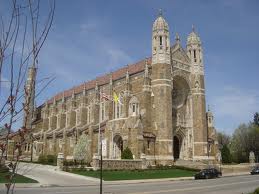
The picture at the beginning of this post and following are of the Rosary Cathedral in Toledo, OH.  The first time I was there was with the Toledo Symphony Chorale in singing the Bruckner 9th Symphony w/voices.  It took my breath away then and still does.  God’s presence was so visible.  I am in awe of what God allows man to do so He can be praised and worshiped   Don’t get me wrong,  I worship indoors, outdoors, and all the places in between, but I believe that are places that God has set aside from the ordinary to give us a glimpse of His great glory.
Rosary Exterior

Exterior of the Rosary Cathedral in Toledo OH.

Rosary CathedralThe sanctuary in the evening without worshipers.

Rosary OrganThe Pipe Organ located in upper balcony at the rear of the church.

Rosary AltarThe main altar area.

The Stations of the Cross

triptychI spent most of yesterday at the Toledo Museum of Art. (BTW one of my favorite places to visit) I love Monet and Van Goth.   However, for me, the best part of the Museum is the Cloisters.  It is designed to look like a commons area for a monastery or convent.  Around the  room are placed many Christian art pieces.  My favorite is a very small triptych of the Stations of the Cross.  Thinking about the pictures and their significance to the believer I decided to do some research as to what these ‘stations’ were.

This liturgy (set of scriptures) is often used on Good Friday to focus the mind on Jesus’ final week.  The stations range from seven to fifteen.  Interestingly, I found only one that included the Resurrection.  This made me wonder what is the point of the Cross without the Resurrection?

The stations and their matching Scripture:

gardenJesus in the Garden of Gethsemane.  Matthew 26:36-41

judasJesus is betrayed by Judas and arrested.  Mark 14:43-46


sanJesus is condemned by the Sanhedrin.  Luke 22:66-71


deniedJesus is denied by Peter.  Matthew 26:69-7


judgedJesus is judged by Pontius Pilate.  Mark 15:1-5, 15


scourgedJesus is scourged and crowned with thorns.  John 19:1-3


bearsJesus bears the Cross.  John 19:6, 15-17


helpedJesus is helped by Simon to carry the Cross.  Mark 15:21

womenJesus meets the women of Jerusalem.  Luke 23:27-31


cruxJesus is crucified.  Luke 23:33-34


thiefJesus promises His Kingdom to the good thief.  Luke 23:39-42


marryJesus speaks to His mother and the Beloved Disciple (John)  John 19:25-27

diesJesus dies on the cross.  Luke 23:44-46


tombJesus is placed in the Tomb.  Matthew 27:57-60

aliveHe is risen! As He said!!!!!


I sincerely hope those of you reading this will take the time to look up these scriptures and ponder the Via Dolorosa.  Another name for the Stations of the Cross.

Father, You alone created this event to pave the way for our sins to be forgiven.  The Last Sacrifice has been made.  The Lamb is on the Throne.  He is Risen!  Amen and Amen!

Always Forgiven!

ResurrectionWE CANNOT OUT-SIN HIS FORGIVENESS!!!!

For Heaven’s sake don’t even think that I would ever suggest even trying.  One of the ways we get ever closer to Jesus likeness is our whole-hearted desire not to sin.  But we are human and we are sinful and that’s something we simply can’t ignore!

In Psalm 103:2-3 David tells us that we are not to forget His benefits and one of these is the forgiveness of sin.  For me, David’s words speak mountains of truth about forgiveness.  His story helps us understand that even the one (David) who had a Heart like His could and would sin!  David depended on God’s forgiveness, asked for it and it was given. Fully!

God is the God of the second, third, forth….chance.  Take a look at Jonah 1:1-3.  God told him to go to Ninevah and preach against its wickedness.  Jonah tried to run away and had the adventure and epiphiny of his life.  (Yes, my God is the Only One who could keep a man alive in the ‘belly of a whale’!)  Jonah 3:1 says the LORD spoke to him a second time and said go to Ninevah and proclaim the wickedness of the Ninevites.  Jonah obeyed!  God will forgive our disobedience but does expect to eventually obey.

Jesus tells us clearly in Matthew 6:14-15 that we must forgive others when they sin against us.  If we don’t the consequence is to big to imagine…the Father will not forgive us.  We are to be the picture of God to those around us.  If there is no way to out-sin God’s forgiveness then there is no sin of another that we can’t forgive.

Mighty, Awesome, Forgiving LORD!  Forgive my sins, the ones I know and the ones I don’t.  Give me Your super-natural ability to forgive those who have and will sin against me in some way.  Nurture in me a heart of forgiveness!  Make it so!!!

“It is Finished!”

Beautiful pictograph of Christ in the Garden!

Bill Sweeney's avatarUnshakable Hope


garden praying

Sweating drops of blood, in anguish I prayed,

asleep

While friends sleep in the cool of the night’s shade,

 betrayed

A crowd, a commotion; with a kiss I am betrayed,

crown

Scorn and ridicule; with a crown of thorns and a royal robe I am arrayed,

 stripes

With the shards of a crude whip my body is beaten and flayed,

crucify

“CRUCIFY HIM” came the verdict of the angry brigade,

jesus on cross

Hands and feet nailed to a cross, as a trophy I was displayed,

jesus tomb

“It is finished!” In a dark tomb my body was laid,

 risen jesus

Hell and death defeated; for you the price of sin I paid!

“God demonstrates His own love toward us, in that while we were yet sinners, Christ died for us.” (Romans 5:8)

View original post

Colorful Worship

I discovered that God is very explicit about the colors He wanted used to decorate the Tabernacle while reading Exodus 26.  He told Moses to use blue, purple and scarlet.  I began to wonder why these colors?  What is important about them?

The colors are used for several articles in the tabernacle: the curtain – Ex. 26:1, the drape that separates the Holy of Holies from the rest of the tabernacle – Ex. 26:31, the High Priest ephod – Ex. 28:15, are only a few examples.

tzitzitThere is no mention of what the colors stood for but there could be a direct relationship to the idea that Jesus is fully God and fully man.  (According to Jewish scholars.) Blue always represents Yahweh.  In the tzitzit, the prayer shawl, there is a blue thread to symbolize God and His Commandments.  There is also a scarlet thread to symbolize mankind.  Woven between these colors is purple which is a combination of the primary colors – red and blue.  God (blue) and man (red) were separated by the sin in the Garden of Eden.  God never intended to leave it that way.  His plan was to have a go-between to restore the fellowship between Himself and His creation.  The go-between would be all God (blue) and all man (red), our Jesus (purple).

The colors also represent other aspects of the Judeo-Christian culture.  Holy of HoliesPurple is the color of royalty.  Jesus is the King of the Kingdom and would rightfully wear a purple robe.     It is also the color of the Royal Priesthood. Blue is the color of God’s chosen people dating back to the time of David.  The restored throne of David is described in Ezekial 1:26 as being made of sapphire (blue stone).  Red is a primary color and can not be made from any other color(s).  It is interesting that the Hebrew root word for Adam is oudem which means red clay.   Red symbolizes atonement, sacrifice, life, death, and flesh.  

I found it interesting to learn what these colors may mean.  I do not intend this to be any more than interesting information that may make your study of the Word more informative.

Heavenly Father, what a heritage You have provided for us.  Help us to remember, in whatever way necessary, that You alone are God.  Make it so!