
Pleasing Who?

Are you a people pleaser?  Should you be a people pleaser?  Who really benefits?  Who are you really trying to please?

Pleasing others, pleasing self, pleasing God…Where does it stop?  Better yet where does it start?  Hebrews 13 is sub-captioned ‘How to Please God’ in Todays English Version of the Bible.  This list of How To’s is good place to start understanding.

First and foremost we are to please God and when that concept is firmly in place it is a natural progression to pleasing others.  So………

Love one another is the top of many of the lists in the Bible.  The easiest way to do this is to take ourselves out of the picture.  An old cliché says “Let go and let God”.  Jesus gave these two commandments – Love God.  Love others.  That pretty much says it, doesn’t it?

Welcome strangers in your homes.  This one gets up close and personal by saying ‘in our homes’.  Ray and I have made this part of our home life and have been blessed by having the opportunity to share and model Jesus to family and new friends from around the world.

Remember those who are in prison as if you were there with them…That speaks for itself yet I’d be willing to say there’s such a prevailing judgemental attitude that even the thought of following through on this is repulsive.  I’m often reminded by the Spirit within…There but for the grace of God go I.  Pray, send a note, visit…

Blessings to you and yours!

Marie

Heavenly Father, help us to read Your Word with the desire to apply it consistently to our lives.  Show us your mercy as we struggle to put You first.  Help us become more like You.  Grant us Your peace.  We give You praise and thanks for sending Jesus in whose name we pray.  Make it so!

Book Review – New Testament Breakthrough Version

coverfront200

Have you ever wondered why there are so many words in the Bible that seem to mean the same thing but when applied to the passage it doesn’t mean what you think you should?  The author of this translation spent more than 30 years carefully researching word meanings and applying that this work.  His work comes from the fact that the Bible was translated over 600 years ago and the words used then are not the same as they are now.  Word meanings change over time and with that it becomes difficult to know what a word meant 600 years ago and how it applies to life today.  If you want to check this out head over to http://www.breakthroughversion.com and check out the comparison charts.  They are informative and give an excellent picture of how the author researched to make this a usable resource.

With that said let me say that I, personally, believe in the total inerrancy of the Word.  I believe that it is and was totally ‘God-breathed’ as it says in 2 Timothy 3:16.  I also believe it is totally our responsibility, as believers, to check out any passage or translation that does not ‘ring true’ for us with all the resources we have.  So when I had a question about a passage I went to my Key Word Hebrew-Greek Study Bible, any or all of the commentary’s I could find, a variety of other study Bibles, and did on-line research when necessary.  Guess what?  I never found a time when this translation was inaccurate or not applicable.

I received a copy of this Bible from Breakthrough Bible Publishing for the sole purpose of reading and review. The thoughts and comments in this review are totally my own and influenced only by my personal and life experiences.  I have spent the past 6 months using this translation in teaching, study and worship experiences.  It has shed light on some passages and taken me to new thoughts on things I already thought I knew.  It is an excellent resource for any Bible teacher and I am delighted to add it to my library and highly recommend it for yours.

Check out the Blog Hops tab above to see where I’m sharing this post.

Blessings to you and yours!

Marie


Quit Gloating

Have you heard this? “I knew that would happen!” “S/he got what s/he deserved!” “Told ya!” There’s a word for enjoying another person’s consequences.  Epicaricacy means ‘delight in another person’s misfortune’.

God has plenty to say about this and when that happens we can know where He stands on the issue and what He wants us to do about it.  So let’s dig in…

Do not gloat when your enemy falls

God knows everything, every thought, every moment of our lives.  He knows what we’ve done, said, or thought.  You cannot hide from Him.  Sure, we know when someone has failed or worse, sinned.  God says, “Let Me handle it!”  The writer, Solomon, is saying that if we dish out disapproval  He will turn toward us instead of the person it’s aimed at.  Trust me, I’d rather have someone fail miserably than have God point His finger at me.

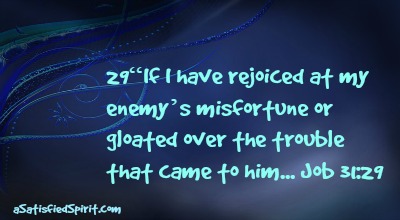
If I have rejoiced at my enemy's misfortune...

Job 31 is a list of the ways Job could have sinned and hidden in it is the verse above.  Read the whole chapter and you’ll discover that Job understood, totally, what God wanted him to do and he practised it.  He was not a gloating, self-centered person.  He had a very clear picture of what God wanted and he followed through.

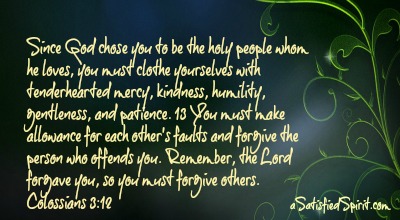
Since God chose you to be the holy people whom He loves

And so, what does God want of us?  We are to be merciful.  We are to choose kindness and gentleness.  We are to model patience.  We are to forgive like God has.

Marie

One Word for 2016 – CONTENT

Each year I select a word that I will focus on for the coming year.  Last year it was ‘stillness’.   This year it will be ‘content’.  I will be focusing on 1 Timothy 6:6-7 and Philippians 4:11.

OneWord 2016


My concept of being content is in knowing that I truly have all I need and God will provide for the future.  My goals include simply learning  to trust and rely on God, choosing a more simple lifestyle, and always making Him the center of my decisions and relationships.

If you’d like to join me on this journey, perhaps choose your own word for the year, hop over to OneWord 365 and let’s do this together.

Blessings to you and yours!

Marie

Red and Green

The Holly and the Ivy - Olde English Carole

The Holly and the Ivy – Olde English Carole

It is not entirely happenstance that Red and Green are the colors of Christmas. They are often mentioned in the Bible.  Red is often used to refer to blood and can be interpreted as both life and death (i.e., Jesus blood gives life, Leviticus 17:14 tells us the life of a creature is in the blood).

Red is often used to refer to blood and can be interpreted as both life and death (i.e., Jesus blood gives life, Leviticus 17:14 tells us the life of a creature is in the blood).

Red and scarlet most often symbolize sin.  For instance, check out Isaiah 1:18 and Joshua 2:18. Notice that in both of these scriptures the use of red also points to grace.  In Isaiah sin will be washed whiter than snow and in Joshua the red cord keeps Rahab and her family safe, forgiven of her sin.  Exodus 12:7 tells us that God told the Israelites to spread the blood of a lamb on the doorpost so that when the Angel of Death came by they would safe.

In the sacrificial system of the Old Testament, the blood was a large part of the ceremony.  Offering the blood of the animal stood in the place of the sins of the person.  This was a temporary solution to the sin problem.  Jesus’ blood (life) was required for the final sacrifice.  At that point in time, the sacrificial system was no longer needed.  Red now is a symbol for life through the blood of the Lamb.

Green often describes life and rest.  Psalm 23:2  tells us He gives us rest in green pastures.   Psalm 52:8 says, “But I am like a green olive-tree in the house of God: I trust in the mercy of God for ever and ever.”

Green trees often refer to nations. “And all the trees of the field shall know that I, the LORD, have brought down the high tree and exalted the low tree, dried up the green tree and made the dry tree flourish; I, the LORD, have spoken and have done it.” Ezek 17:24.  All nations and peoples will recognize God.

A green tree is also used in Jeremiah 17:8 to describe a righteous man.  “For he shall be as a tree planted by the waters, that spreads out roots by the river, and is withered by heat or draught.” 

Green as it is first used in Genesis, is the Hebrew word ‘yer eq’ and is used in verse 30.  God is telling us that He provides all that we need for life by giving us the food we need.

As you ponder these words in your heart I wish you love, joy, and peace during this beautiful, meaningful season.

Blessings to you and yours!

Marie